Death, nothingness and the meaning of life
La piel del tamborDeath, nothingness and the meaning of life form a central tension in the novel’s treatment of faith: human beings know they will die, yet cannot know whether their lives belong to a providential design or are accidents in an indifferent universe. Príamo Ferro finds in religion a consolation that may not answer that uncertainty but can shelter people who face it; Lorenzo Quart understands the need while remaining unable to accept it without reservation. The church’s protective imagery and the unexplained deaths within it keep the question open rather than resolving it.
Human Smallness and Discipline
Quart’s lucidity is presented as a burden. He cannot wholly approve the natural order, but that awareness supplies no excuse or refuge in return. For a priest, or anyone whose work depends on believing that humanity occupies a privileged place in the harmony of the universe, the recognition of human insignificance is especially unsettling. In Quart’s case, discipline and willpower keep him from crossing into weakness, apathy, or despair; they do not erase the truth that threatens to overwhelm him.
That tension is visible after Ferro celebrates Mass. The congregation has dispersed, and Quart remains alone in the dim church. He recalls the priest at the altar, speaking ritual words to worshippers who can be relieved, at least for a time, of the burden of being mortal by hope in an all-powerful father, another life, and justice beyond death. The building’s old stones, worn by the steps of people dead for centuries, make mortality palpable, while the service’s promise offers a counter-image: the hope that individual lives are not simply extinguished without remainder.
Ferro’s Experience of Mortality
Ferro’s reflections arise from a long life spent alongside suffering and death. At sixty-four, he says that his reading of ancient philosophy—from Socrates to Saint Augustine—has left him not with a system of answers but with a bitter-sweet melancholy and disillusionment. What he knows of human beings is that they remember, are afraid, and die. The statement reduces philosophical learning to the mortal experiences that no doctrine can make abstract.
His account of priesthood gives that knowledge a personal history. For a quarter of a century, he served dying people who clung to his hands because he was their only consolation. He carried the last rites to the elderly, celebrated Mass in a small, nearly empty church, and lived in severe loneliness, feeling forgotten by his bishop and the people around him. He had spent years addressing God without receiving an answer. His silence about that absence is not presented as a tidy rejection of faith: he seems, for a moment, still to give an answer the chance to come.
Quart meets this testimony with the alternative that birth and death occur either according to a plan or by accident. He offers no proof for either possibility; the formulation allows the conversation to continue without pretending to settle it. For the first time, he understands the man before him, and Ferro recognizes that understanding in Quart’s response. Their brief accord rests not on certainty, but on a shared recognition of the question’s weight.
Faith as Consolation and Shelter
Ferro asks how the meaning of life can be preserved in a world stamped by death. A person knows that extinction is coming and fears that, unlike kings, popes, and generals, no memory of an ordinary life will remain. The thought that there must be something more becomes, in his account, the ground from which faith grows: hope and consolation against a universe otherwise liable to seem like meaningless chaos. His suggestion that even the Pope may no longer believe in God is framed as a bleak possibility, not as an established fact.
Quart challenges the moral cost of this consolation, calling it alienation and comparing Ferro’s church to seventeenth-century television. Ferro does not deny that religious forms compete for attention; he argues that religious art has long used symbols to hold people’s attention and that modern spectacle does not necessarily make faith more sustaining. People need symbols as shelter from a cold world, he insists, and the church bears responsibility for those who still come to it in innocence and trust. His defense is therefore practical as well as theological: a promise need not explain death to offer the frightened a place to seek hope.
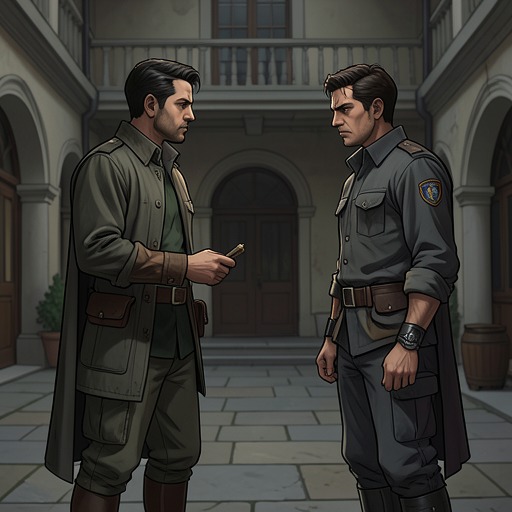
The exchange ends not in agreement but in proximity. After Ferro concludes the argument, he and Quart stand beside one another at a window overlooking the river, silent as the evening passes. Ferro says that when seduction ends, they too will be finished, because logic and reason mean an end to their kind of religious life. Yet while a poor woman still needs to kneel for hope or consolation, he believes his small church must remain standing. He describes priests like himself as the old, patched skin of a drum on which God’s glory still sounds. The image makes religious practice both precarious and persistent: an inherited, worn form that continues to answer a human need.
Symbols, Deaths, and Uncertainty
The Virgin statue gives Quart a way to read the church’s symbols without reducing them to a single explanation. With Captain Xaloc’s pearls running over the figure like tears, the image gathers associations of mother, refuge, protection, fear of darkness, cold, and nothingness. Quart reflects that related figures and symbols have evolved across religions and centuries; whether named Isis, Ceres, Astarte, Tanit, or Mary, the image can condense the desire for shelter. Its layered meanings do not prove that the universe is governed by a caring order, but they show how religious imagery gives form to the need for protection from death and the unknown.
The two deaths associated with the church sharpen that uncertainty. Quart considers the fatal piece of plaster that struck Father Urbizu and the municipal architect’s fall from the roof. The police report rules out human involvement in Urbizu’s death, while witnesses saw the architect slip; these details appear to weaken the case for deliberate interference. They do not establish a supernatural cause. The events remain available to several explanations: Ferro and Vísperas attribute them to God’s anger, Quart considers destiny, and he also imagines chance as the work of careless, capricious gods. The competing explanations preserve the novel’s uncertainty about whether suffering belongs to a plan or occurs without one.
Quart’s own response to that uncertainty is neither serene belief nor simple disbelief. Elsewhere, alone after showering, he imagines himself as a solitary Templar walking beneath a godless sky and tries to pray, testing whether the words can reach beyond the emptiness he senses within them. The effort leaves him in profound loneliness and sadness. It echoes the church discussion from another direction: ritual and faith may offer consolation, but for Quart the attempt to believe also exposes the distance between the words and any assured answer.
The Meaning of an Unanswered Question
The novel connects mortality to memory, but does not let remembrance fully defeat death. Ferro’s dying parishioners seek comfort in his presence; Quart’s attention to the old church, its worn stones, and its accumulated symbols makes lives and histories perceptible even where no final account of them is available. Yet the fear that ordinary people will leave no memory remains part of Ferro’s argument, and Quart’s clarity denies him an easy assurance that the church’s promises are true.
This unresolved tension gives the church’s defense its spiritual significance. Ferro treats its fragile, old forms as necessary so long as people need consolation; Quart can understand the reason without abandoning his awareness of human smallness. The unexplained deaths likewise resist a definitive moral: they neither prove divine judgment nor conclusively disclose a meaningless universe. The subject’s force lies in that unsettled space, where death is certain, its larger purpose is not, and faith persists as a human hope rather than a demonstrated answer.